An Over-Policed Campus
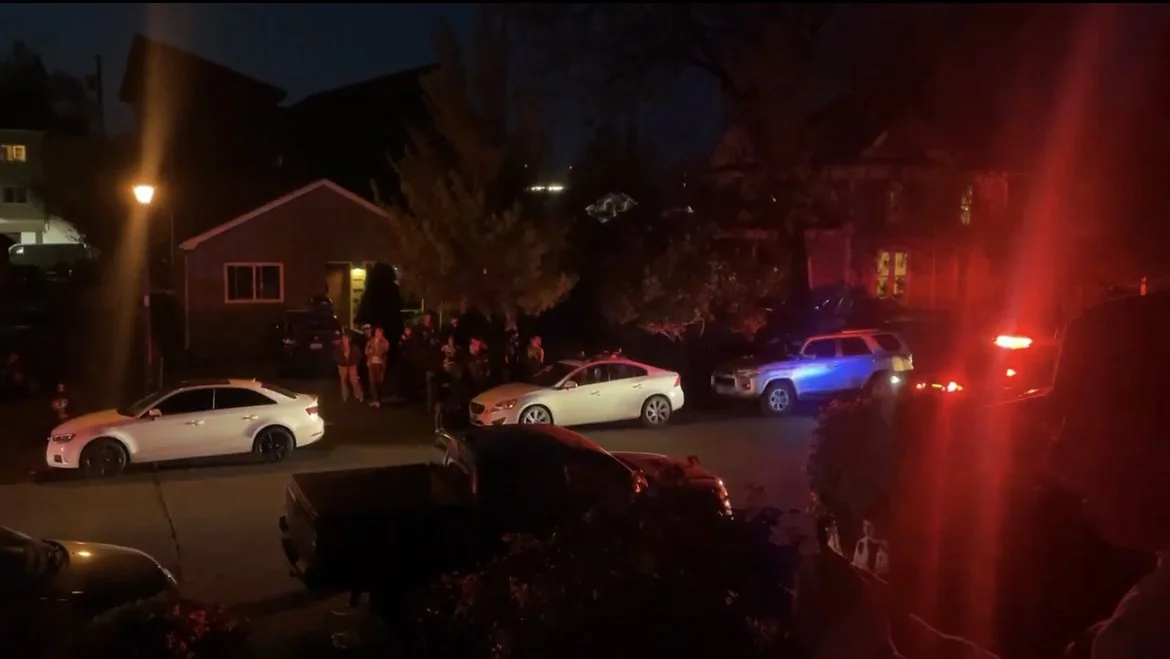
Two EPD patrol cruisers (one not pictured) issuing a noise violation to a house concert on April 24th.
By: Bentley Freeman
Written: 12/5/22
On Saturday, Oct. 30 at 11:30 pm, Jack Soutenberg, a member and resident at the Phi Gamma Delta (Fiji) House on 791 E 15th Ave, went downstairs to find a police officer standing in his living room doorway. After approaching the officers to ask what he could do to help, he was unceremoniously arrested after telling them he lived at that address.
“Without any hesitation, I was arrested and put in a prisoner transport vehicle,” Stoutenberg, a business student and junior at the University of Oregon, says to Eugene City Council on Nov 14. during a public forum.“I was read my rights. I was not told why I was being arrested. I spent more than an hour in the van handcuffed and I was treated like a criminal. I spent the entire night in jail over an unruly gathering.”
The police waited outside his home for around 2 hours until the arrest warrant was cleared around 1:30 am the next day. When it was cleared, anyone inside the home was detained and arrested. Doors were kicked in, laptops and speakers were seized and people only wearing undergarments were handcuffed and placed into a prisoner transport van. Stoutenberg says he has lost his trust in the EPD and is worried that other students may hesitate to call 911 because of over-policing.
“EPD needs to look in the mirror and ask themselves if they are upholding their oath to protect and serve,” Greg Rachal says during the forum, another member of Fiji who had his laptop seized and kept by police for three weeks. He says that because of this, he was unable to complete work on his upcoming midterms.
Stoutenberg and 24 other fraternity members living in the house were detained and arrested that night between 1:30 am and 2:30 am. Stoutenberg’s fraternity was throwing a Halloween party that weekend, and to his knowledge, they were only arrested for violating the city's noise ordinance from 2013.
There were 25 people in total charged with prohibitive noise for violating Eugene municipal code 4.083 which declares any loud noise from the hours of 10:00 pm to 7:00 am to be noise disturbances. “Except for three people, a lot of the prohibitive noise misdemeanors [against different members of his fraternity] were dropped,” Stoutenberg says. One of their members Varun, who would not give their last name, is a foreign student from Mumbai, India and after being charged has become worried about deportation.
At the public forum, over 100 UO students showed up to support students who were speaking. The meeting room quickly reached capacity, with about 20 UO students being left outside the doors unable to attend. During the meeting, students would silently wave their arms in support of speakers who called out EPD’s actions. Councilors Emily Semple, Jennifer Yeh and Matt Keating, along with Mayor Lucy Vinis thanked the students for having the courage to come and share their opinions.
While many members of the fraternity came out to the public forum to show their support, Associated Students of the University of Oregon (ASUO) encouraged any student to come and voice their opinions about the EPD’s Party Patrol program which began in 2013.
At the public forum, over 100 UO students showed up to support students who were speaking. The meeting room quickly reached capacity, with about 20 UO students being left outside the doors unable to attend. During the meeting, students would silently wave their arms in support of speakers who called out EPD’s actions.
Several told stories of their personal experience dealing with EPD giving them citations and how that was negatively affecting their mental health. UO student and ASUO representative Meghan Turley offered suggestions during the forum to attempt and reach a middle ground. “The way forward is going to require genuine and good faith efforts,” Turley says.
According to the ASUO, there have been 60-70 citations issued each weekend since the fall term began in late September.
During the public forum, multiple residents of the Jefferson-Westside neighborhood came up to the podium to speak about both a lack of police presence and long police response time. “You’re preying on students that are paying to come here to school. I pay taxes. I’m getting no help,” Kelly Shunk, a Jefferson-Westside resident says. “I’m afraid to go outside of my house.”
Another Jefferson-Westside resident, Bill Armstrong, says he has called EPD dozens of times to report drug activity, seeing little to no response from them.
“The noise ordinance in Eugene is overreaching and has been used by the police as a pretext and at times with no warning to cite large groups of college students,” Tara Parillo says, an academic advisor with the UO for over seven years. “These interactions with police are making students feel like they cannot trust police officers and that the police are unreasonable and unnecessarily harsh.”
While the program was halted during 2020’s COVID-19 pandemic, it began again during spring this year after several large unruly gatherings were held, according to EPD. “We really begged that things calm down in the fall, and they were kind of receptive,” Luda Isakharov, ASUO President says. “But in the fall, things just got worse.”
Isakharov had multiple friends who were stopped and questioned by EPD officers but were let off with warnings. She and the rest of ASUO have been attempting to make progress with the EPD with little result. “We've been meeting with — and continuing to meet with the EPD, UO administration and community members to try and find solutions. There's been no progress.”
ASUO’s legal services have been offering help to students who have been given citations or been detained but have since become completely overwhelmed with the number of cases being brought to their attornies.
ASUO was able to meet twice with the EPD to discuss the issue. Once with the chief of police, Chris Skinner on August 4th and once with Captain Billy Halverson, who oversees party patrol, on October 18th.
EPD pays their officers who work with the Party Patrol program over time. According to the city of Eugene, it costs an average of $800 to respond to a single unruly gathering.
“We're disappointed because we used to have trust in them. We feel like they broke that trust,” Stoutenberg says.