Turmoil on the Soil
Farmers struggle to find solutions amid government regulations, corporations and climate change.
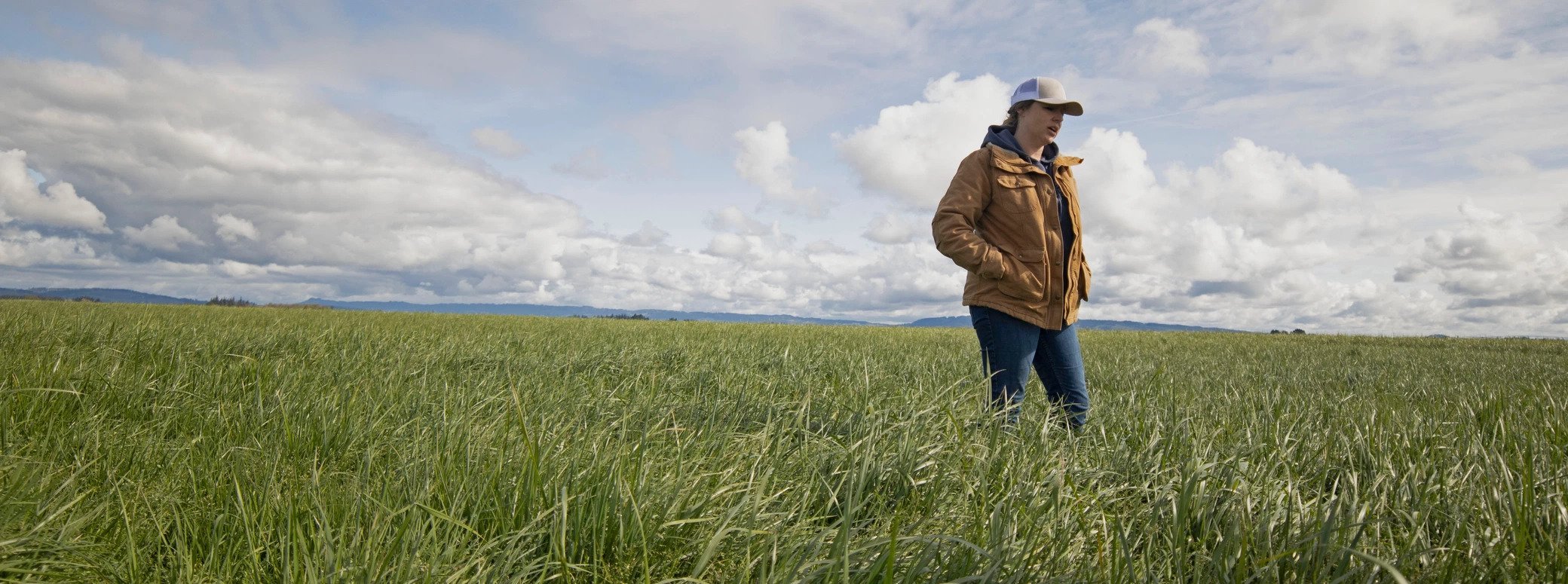
Farmer Brenda Frketich looks over her field of grass seed in St. Paul, Oregon

By: Bentley Freeman
Published on: 6/1/22
“When you have folks who are trying to mandate what we're doing here on the ground, it gets really frustrating,” said Brenda Kirsch Freketich, owner of Kirsch Family Farms in Saint Paul, Oregon. “Because they don't understand or they don't even take the time to understand what we're dealing with and the challenges that we're coming up against.” Freketich says she and other farmers are frustrated with Oregon’s state government as it continually leaves them out of the conversation about agriculture and climate policy.
However, it’s not just stringent government policy causing family-owned farms to struggle; it’s the unpredictable weather patterns of the last few years and the continually rising land cost.. Farmers like Freketich are constantly under duress because of these factors, but they say there are still positives to the business.
Freketich has been involved in her family farm since she graduated from Loyola Marymount University in Los Angeles in 2006 and loved it. “For me, farming has been really great. Because it's just full of great people,” said Freketich. She is the third-generation owner of the farm and says that she was drawn back into it because she liked Oregon compared to California.
To her, people are a big part of the businesses, but all the outside factors of production, land and labor cost are forcing farmers, especially family-owned farms, to be pushed out. Oregon is a big state for agricultural products, with 1% of state residents being agrarian l workers. According to Frekertich, a lot of the strain that’s being placed on them primarily comes from government overreach.
“Every year, every session there's something that comes up that we have to go fight or stand up for or discuss and be prepared for,” says Frekertich. Oregon recently passed House Bill 4002, which mandated a 40-hour week threshold for all agriculture workers. Any work done over that 40-hour mark needs to be paid in overtime, which is about 1.5 times normal pay rates. While paying workers a fair wage for more work than expected is good, this puts unnecessary stress on family farms that cannot afford more than what they are already paying.
For Frekertich, her farm is facing a financial obstacle that they might not be able to overcome. Farming requires unusual amounts of hours during a harvest, but the Oregon Farm Bureau claims that HB 4002 will cause farmers to cut hours after the 40-hour-a-week threshold. This hurts both the workers and the farmers because they work fewer hours, and farmers cannot afford to hire more hands during stressful periods.
Tony Smith, a hazelnut farmer and owner of Smith Family Farm in Saint Paul, argues that while policies implemented to help protect the environment and workers rights are good in theory, the solution to fixing these issues is not to target small family farms that are already facing economic turbulence.
HB 4002 is not the first instance of passing a law without considering its implications on small, locally-owned family farms. When Oregon passed laws giving farmers benefits for implementing systems with low emissions or water usage, farmers like Freketich were left behind because they had already taken the extra step to be as sustainable and environmentally friendly as possible. Freketich and her family had already invested in a linear irrigation system, a watering system with 90% efficiency.
They say no tax break from the government because the state had failed to help her grandfather and any farmer who had already made that push for less water waste. “We can't get more efficient. So we actually don't qualify for any tax breaks, or any part of this program, because we've already done these efficiency processes since it doesn't look back,” said Freketich. Kirsch Family Farms has already made the jump into much more sustainable forms of traditional farming.
Family farmers also face other kinds of opposition, most notably from the turbulent weather patterns that Oregon has experienced in the last few years. Smith says that because of how dry last year was, he had to water his crops six times throughout the year, compared to how he would usually do it twice during one yearly crop rotation.
“Climate change or that drying of climate over time, I think will definitely push farmers to make changes to a large degree,” said Smith. His farm is 321 acres large, with his hazelnut orchards being in 20-acre blocks. Each block contained around 2000 hazelnut trees, but he lost about half of his two-year-old orchard to the dry season, “Out of 2000 trees I lost over 1000 trees. I lost over half my orchard,” said Smith. Freketich saw a decrease in her yield of crops last year, which forced them to use up more water than they normally would before a harvest.
Freketich and Smith both have water rights to the nearby rivers and groundwater, which allowed them to supplement that loss of rainwater. These rights allow farmers to keep their soil to get the water it needs, while also allowing them to farm a much wider variety of crops. However, those rights to pull that water from out the ground have become increasingly rare to come by.
Smith keeps his farm very sustainable, but Willamette Valley farmers all rely on a steady and predictable rain pattern. While last year was dry throughout spring, this year saw more precipitation throughout the first half of the year. Farmers like Freketich, Smith and Jason Hunton, a grass seed and grain farmer near Junction City, Oregon, all rely on consistent weather patterns that are becoming much more frequently unpredictable.
Hunton is who aims to keep the dollars his farm creates in the community. He works with a local grain mill, Camas Country Mill, to sell his bread back to the larger Lane County community.
“On some fields, there are different crops that have a different time of pollination. And some of that came in kind of towards the end of that and scorched some of the plants from before the seed had finished maturing in the plant head.… It feels like we're having earlier springs than usual and a longer fall,” said Hunton. Almost every farm in the area was affected by last year's dry spell and has to contend with the ever-increasing tumultuous weather patterns.
Hunton is proud to say that almost all of his operating budget is able to stay within a 14-square-mile radius of his farm. He wants the capital that his farm creates to support the local tire shop and his local basketball team, some examples he gave.
However, with bills like HB4002 being passed, he is being pushed to think more conservatively with his dollar. For Hunton and his farm, his annual labor costs will increase by $30,000 next year, which will increase his labor budget by 20%. Farmers are facing challenges on multiple fronts, pushing them to make tough choices when it comes to labor, sustainability, and how they sell their products.
Freketich, Smith and Hunton are all family farmers that came into the business because of their passion for the work, but these challenges have made it difficult to pivot to new solutions. However, Freketich is confident that they can see it through. “Farmers are solution-oriented, we come up against a lot of challenges,” he said.